
High Speed Automatic Blister Packing Machine for Efficient Pharma Packaging
A High Speed Automatic Blister Packing Machine is an important part of modern pharmaceutical packaging operations where productivity, consistent pack quality, material utilization, and reliable operation are essential. For manufacturers handling tablets, capsules, dragees, and other regular-shaped solid pharmaceutical products, an automated blister packaging system can integrate forming, product feeding, sealing, indexing, and punching into a continuous production process.
Jicon Technologies has been developing pharmaceutical packaging and processing machinery since 1984. Its portfolio includes automatic blister packaging machines designed for pharmaceutical manufacturing requirements, along with capsule filling, tube filling, cartoning, and other packaging solutions.
Table of Contents
- What Is a High Speed Automatic Blister Packing Machine?
- How Does an Automatic Blister Packing Machine Work?
- Key Features of BLISTRIP-II
- Advantages of High-Speed Blister Packaging
- Packaging Materials and Product Applications
- Why Quick Changeover Matters
- Blister Packaging and Pharmaceutical GMP
- Choosing the Right Blister Packing Machine
- Why Consider Jicon Technologies?
- Frequently Asked Questions
What Is a High Speed Automatic Blister Packing Machine?
A High Speed Automatic Blister Packing Machine is an automated packaging system designed to produce sealed blister packs at high production rates while maintaining controlled and repeatable packaging operations.
In pharmaceutical applications, blister packs are commonly used for tablets, capsules, and other solid dosage forms. The packaging process generally involves forming the blister cavity, feeding the product, sealing the lidding material, indexing the web, and punching or cutting the finished packs.
Jicon’s BLISTRIP-II is designed for packing smaller and regular-shaped solid articles such as pharmaceutical tablets, capsules, and dragees using PVC-Alu packaging materials. According to Jicon’s published specifications, the machine can achieve up to 300 packs per minute for certain slightly curved or flat tablets up to 10 mm in diameter, depending on product characteristics.
The actual production output of any blister machine depends on factors such as product geometry, blister configuration, number of ups, feeding characteristics, forming depth, tooling, and packaging material.
How Does an Automatic Blister Packing Machine Work?
The blister packaging process consists of several coordinated operations.
1. Blister Forming
The forming station creates cavities in the packaging web according to the selected tooling and product format.
For PVC-based blister packaging, the forming process prepares the cavities into which tablets or capsules are subsequently placed.
2. Product Feeding
The product feeding system transfers tablets, capsules, or other suitable products into the formed blister cavities.
Consistent feeding is particularly important because product availability and feeding performance directly influence the usable production rate.
3. Sealing
After the products are positioned in their cavities, the lidding foil is brought into contact with the blister web and sealed.
Proper sealing is an important part of blister-pack quality because the packaging needs to protect the pharmaceutical product throughout handling, storage, and distribution.
4. Indexing
The packaging web moves through the machine according to the programmed production sequence.
Accurate indexing helps maintain the required relationship between forming, feeding, sealing, and punching stations.
5. Punching and Cutting
The sealed web is subsequently punched or cut into individual blister packs or the required pack configuration.
The finished packs can then proceed to downstream operations such as inspection, cartoning, or secondary packaging.
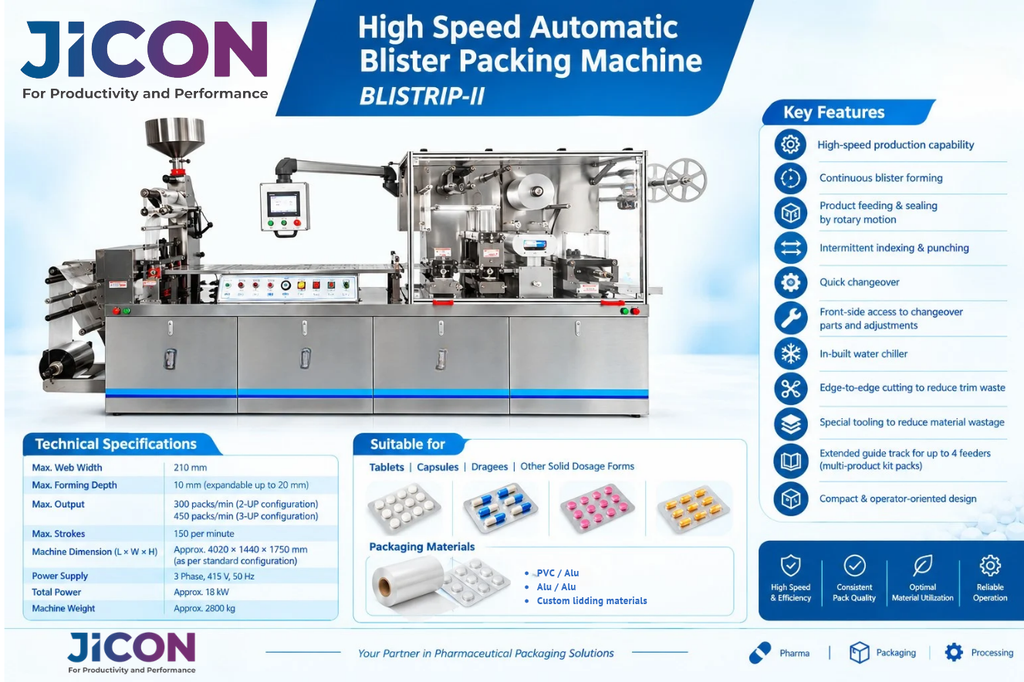
Key Features of BLISTRIP-II
Jicon’s BLISTRIP-II High Speed Automatic Blister Packing Machine is designed around high-speed pharmaceutical blister packaging requirements.
Its published features include:
- High-speed production capability
- Continuous blister forming
- Product feeding and sealing by rotary motion
- Intermittent indexing and punching
- Quick changeover
- Front-side access to changeover parts and adjustments
- In-built water chiller
- Edge-to-edge cutting to reduce trim waste
- Special tooling designed to reduce material wastage
- Extended guide track for accommodating up to four feeders for multi-product kit packs
- Compact and operator-oriented machine design
The published specifications include a maximum web width of 210 mm, maximum forming depth of 10 mm expandable up to 20 mm, and maximum output of 300 packs/minute in a 2-UP configuration or 450 packs/minute in a 3-UP configuration. Maximum strokes are specified as 150 per minute. Actual output remains product- and format-dependent.
Advantages of High-Speed Blister Packaging
Higher Production Capacity
Automated blister packaging can support higher production requirements by coordinating multiple packaging operations within one integrated machine.
For manufacturers handling large production batches, increased machine output can help reduce packaging bottlenecks.
Consistent Packaging Operations
Automation helps maintain repeatable machine movements and controlled packaging sequences.
This is particularly relevant to pharmaceutical manufacturing, where consistent processes and documented controls are important components of GMP systems. The WHO describes GMP as a system intended to ensure that medicinal products are consistently produced and controlled according to appropriate quality standards.
Quick Changeover
Pharmaceutical manufacturers may need to handle different products, pack sizes, and formats.
A machine with accessible change parts and a practical changeover arrangement can help reduce downtime between production campaigns. BLISTRIP-II is designed with front-side access to changeover parts and adjustments.
Material Utilization
Blister packaging involves forming materials, lidding foil, cutting, and tooling. Machine and tooling design therefore have a direct relationship with packaging-material utilization.
BLISTRIP-II incorporates edge-to-edge cutting and special tool design intended to reduce trim waste.
Integration With Packaging Lines
A blister machine may form part of a wider pharmaceutical packaging line.
Depending on the production requirement, blister packs can subsequently move toward inspection, cartoning, serialization or other downstream packaging processes.
For manufacturers looking for broader packaging solutions, Jicon also offers cartoning and other pharmaceutical packaging machinery.
Packaging Materials and Product Applications
Blister packaging technology can be selected according to the pharmaceutical product, required protection, packaging specification, tooling, and regulatory requirements.
Jicon’s product range includes different blister packaging technologies. Its ALBLIS automatic flat-plate blister packing machine is described for Alu-Alu and PVC-Alu blister packs and applications involving tablets, capsules, dragees, vials, ampoules, tubes, and creams, subject to machine configuration and product suitability.
The BLISTRIP range is designed for specific high-speed blister packaging applications using PVC-Alu materials. BLISTRIP-Ixt, for example, is described as a single-track automatic blister packing machine with continuous forming, feeding, and sealing operations.
Therefore, selecting a blister machine should not be based on speed alone. Product dimensions, material structure, cavity configuration, required pack size, tooling, and desired production output should all be evaluated.
Why Quick Changeover Matters in Pharmaceutical Packaging
Modern pharmaceutical production frequently involves multiple SKUs and different packaging formats.
A long changeover can increase:
- Production downtime
- Packaging-material consumption
- Operator workload
- Line scheduling complexity
- Overall equipment utilization challenges
A High Speed Automatic Blister Packing Machine should therefore be evaluated not only by its maximum theoretical speed but also by how efficiently it can transition between approved production formats.
BLISTRIP-II incorporates accessible changeover parts and adjustments, while Jicon highlights quick and easy changeover as part of the machine’s design approach.
Blister Packaging and Pharmaceutical GMP
Pharmaceutical packaging is not simply a mechanical operation. Packaging processes form part of the overall pharmaceutical manufacturing and quality system.
WHO guidance explains that GMP covers operations throughout pharmaceutical production, including packaging and related activities. GMP aims to reduce risks such as cross-contamination, mix-ups, and incorrect labelling.
WHO guidance also identifies packaging quality as important for protecting pharmaceutical products against external influences, physical damage, contamination, and other risks, while ensuring appropriate identification and information.
For this reason, pharmaceutical manufacturers should evaluate blister packaging equipment in relation to their validated processes, quality systems, packaging materials, product characteristics, cleaning procedures, documentation, and applicable regulatory requirements.
Important: Machine selection does not by itself establish GMP compliance. The equipment, facility, processes, materials, documentation, validation, and quality systems must be assessed according to the applicable regulatory requirements.
Choosing the Right Blister Packing Machine
Before selecting a blister packaging machine, pharmaceutical manufacturers should consider several technical factors.
Product Characteristics
Evaluate:
- Tablet dimensions
- Tablet shape
- Capsule size
- Product weight
- Product fragility
- Product feeding characteristics
Blister Configuration
Consider:
- Number of cavities
- Pack dimensions
- Number of ups
- Forming depth
- Required web width
- Cutting configuration
Required Production Output
Do not evaluate machine speed in isolation.
A machine’s practical production output depends on the product, tooling, feeding system, blister configuration, and operating conditions.
Packaging Material
The selected machine should be suitable for the intended packaging material and forming/sealing process.
Changeover Requirements
If the plant handles multiple SKUs, assess the time, tooling, accessibility, and procedures required for format changeover.
Downstream Integration
Consider whether the blister machine needs to interface with inspection systems, cartoning machines, printing/coding equipment, or other packaging-line equipment.
Why Consider Jicon Technologies?
Jicon Technologies was established in 1984 with a focus on pharmaceutical packaging and processing machinery. The company states that it has supplied solutions to customers in more than 50 countries and maintains in-house technical capabilities along with a network of trusted vendors.
Its pharmaceutical machinery portfolio includes:
- Automatic Blister Packaging Machines
- Flat Plate Blister Packaging Machines
- Capsule Filling Machines
- Tube Filling Machines
- Cartoning Machines
- De-Blistering Machines
- Other pharmaceutical processing and packaging equipment
For pharmaceutical manufacturers evaluating a High Speed Automatic Blister Packing Machine, technical discussions should begin with the product, blister format, packaging material, required output, tooling requirements, and downstream line configuration.
Explore Jicon’s pharmaceutical packaging and processing solutions and review its blister packaging machine videos for additional information.
Frequently Asked Questions
What is a High Speed Automatic Blister Packing Machine?
A High Speed Automatic Blister Packing Machine is an automated pharmaceutical packaging system designed to form blister cavities, feed products, seal the blister, index the packaging web, and punch or cut finished packs at high production rates.
What products can BLISTRIP-II pack?
BLISTRIP-II is designed for smaller and regular-shaped solid pharmaceutical products such as tablets, capsules, and dragees. Product suitability should be confirmed based on dimensions, shape, feeding characteristics, and packaging requirements.
What is the maximum output of BLISTRIP-II?
Jicon’s published specifications state a maximum output of 300 packs per minute in 2-UP configuration and 450 packs per minute in 3-UP configuration. Actual output depends on the product and packaging configuration.
Can blister machines handle different pack sizes?
Yes, blister machines can be configured with appropriate tooling and change parts for different packaging formats. The exact range depends on the machine model and its technical configuration.
Why is quick changeover important?
Quick changeover can reduce production downtime when manufacturers switch between products or blister formats. It can also help reduce material wastage associated with setup and adjustment.
Is blister packaging suitable for pharmaceutical tablets and capsules?
Blister packaging is widely used for pharmaceutical solid dosage forms. WHO materials also identify blister packs as a preferred primary-packaging format for tablets and capsules in certain procurement specifications.
How should pharmaceutical manufacturers select a blister machine?
Selection should consider the product, dimensions, packaging material, blister format, required output, tooling, changeover requirements, quality requirements, and integration with the rest of the packaging line.
Conclusion
A High Speed Automatic Blister Packing Machine can provide an integrated approach to pharmaceutical blister packaging by combining forming, product feeding, sealing, indexing, and punching operations within an automated production system.
Jicon’s BLISTRIP-II is specifically designed for high-speed blister packaging of suitable pharmaceutical solid products, with published capabilities including up to 300 packs per minute in 2-UP configuration and 450 packs per minute in 3-UP configuration, subject to product and packaging conditions.
For pharmaceutical manufacturers, the appropriate machine should be selected after evaluating the complete application rather than speed alone. Product characteristics, packaging material, blister configuration, tooling, changeover requirements, quality systems, and downstream integration all contribute to the suitability of the equipment.
Interested in a High Speed Automatic Blister Packing Machine for your pharmaceutical packaging line? Contact Jicon Technologies to discuss your product and packaging requirements.