
Automatic Tube Filling Machine Manufacturer in India
When pharmaceutical, cosmetic, personal-care, or healthcare products are filled into tubes, consistency matters. The right filling and sealing system can influence product quality, production efficiency, changeover time, material usage, and the overall reliability of a packaging line.
For companies evaluating an Automatic Tube Filling Machine Manufacturer in India, the decision should therefore go beyond machine price. The more important questions are about filling accuracy, tube compatibility, sealing quality, automation, hygiene, ease of operation, maintenance, and long-term technical support.
India has developed a strong manufacturing base for pharmaceutical and packaging machinery, making it possible for manufacturers to source sophisticated tube filling solutions locally while receiving engineering and service support closer to their production facilities.
Table of Contents
- What Is an Automatic Tube Filling Machine?
- Why Automatic Tube Filling Matters in Pharmaceutical Manufacturing
- Applications of Automatic Tube Filling Machines
- Important Features to Evaluate
- GMP and Hygienic Machine Design
- How the Filling Process Works
- Aluminum, Plastic, and Laminated Tubes
- Benefits of Choosing an Indian Manufacturer
- How to Select the Right Machine
- Why Jicon Technologies?
- Frequently Asked Questions
- Conclusion
What Is an Automatic Tube Filling Machine?
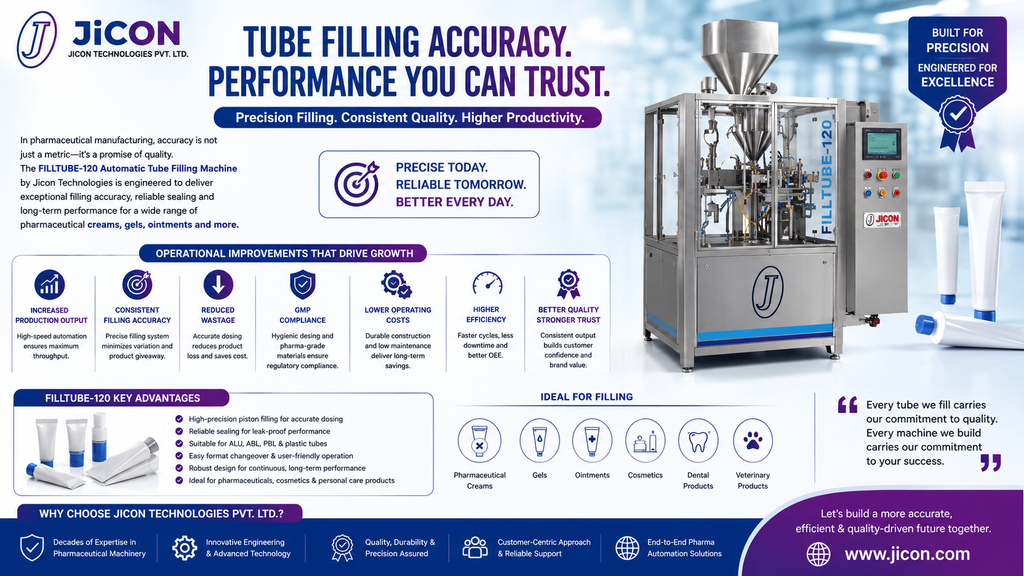
An automatic tube filling machine is designed to automate the process of filling a measured quantity of product into tubes and subsequently sealing or closing them.
Depending on the machine configuration and product requirements, tube filling systems can handle products such as creams, ointments, gels, pastes, balms, and other viscous formulations.
Automation reduces dependence on repetitive manual operations and helps manufacturers establish a more controlled production process.
A modern system can integrate tube handling, product dosing, sealing, coding, and tube discharge into a coordinated sequence.
For pharmaceutical manufacturers, this is particularly important because production equipment must support consistent processing and controlled operating conditions.
Why Automatic Tube Filling Matters in Pharmaceutical Manufacturing
Pharmaceutical production demands repeatability.
A small variation in filling quantity, poor sealing, product dripping, or incorrect tube handling can result in product loss, rework, or quality concerns.
An appropriately designed automatic tube filling system helps manufacturers improve:
- Filling consistency
- Production productivity
- Process repeatability
- Operator efficiency
- Tube sealing quality
- Product handling
- Changeover efficiency
- Overall packaging-line control
The importance of controlled manufacturing practices is also reflected in international GMP guidance. The World Health Organization explains that GMP is intended to ensure pharmaceutical products are consistently produced and controlled according to appropriate quality standards.
That makes equipment selection an important part of the broader pharmaceutical quality system.
Applications of Automatic Tube Filling Machines
Tube filling technology is used across several industries.
Pharmaceutical Industry
Common pharmaceutical applications include:
- Creams
- Ointments
- Gels
- Topical formulations
- Medicated pastes
- Dermatological products
The machine configuration should be selected according to the formulation characteristics, filling volume, tube material and required production output.
Cosmetic and Personal Care
Tube packaging is widely used for products such as
- Skin creams
- Facial products
- Hair-care formulations
- Balms
- Cosmetic gels
- Personal-care products
In these applications, appearance and sealing quality can be just as important as filling performance.
Food and Other Viscous Products
Depending on the machine design and product characteristics, tube filling equipment can also be considered for selected food and other viscous products.
The important point is to match the machine’s product-contact system and filling mechanism with the formulation.
Important Features to Evaluate
Not every tube filling machine is designed for the same production requirement.
Before purchasing, manufacturers should evaluate several technical parameters.
1. Filling Accuracy
The dosing system should be capable of delivering a consistent quantity of product into every tube.
Filling accuracy depends on factors such as
- Product viscosity
- Filling volume
- Dosing mechanism
- Product temperature
- Nozzle design
- Machine speed
A machine should therefore be evaluated using the actual product rather than relying only on catalogue specifications.
2. Tube Compatibility
Tube diameter and tube length can vary significantly between products.
The machine should be capable of accommodating the required tube dimensions and should provide suitable tooling for the selected tube type.
3. Sealing System
Sealing requirements depend on the tube material.
Aluminum tubes may require crimping or folding, while plastic and laminated tubes can require thermal or other suitable sealing methods.
A properly selected sealing system helps achieve a clean and reliable finished pack.
4. No-Tube-No-Fill Function
A no-tube-no-fill system can help prevent product from being dispensed when a tube is not correctly positioned at the filling station.
This is a practical feature for reducing unnecessary product loss and maintaining cleaner machine operation.
5. Easy Changeover
Pharmaceutical manufacturers frequently handle multiple SKUs.
Fast and straightforward changeover can reduce downtime and improve equipment utilization.
When evaluating a machine, ask how long a typical format change takes and which parts need to be replaced or adjusted.
GMP and Hygienic Machine Design
GMP is not simply about the final inspection of a pharmaceutical product. It covers manufacturing operations, equipment, facilities, personnel, documentation, and process controls.
WHO guidance states that manufacturing processes should be clearly defined and controlled to consistently produce products meeting their required quality standards.
For tube filling equipment, manufacturers should therefore pay attention to:
- Product-contact materials
- Machine accessibility
- Cleaning requirements
- Product residue management
- Preventive maintenance
- Controlled filling operations
- Appropriate documentation
- Changeover procedures
The exact machine design should always be assessed against the customer’s product, facility, and applicable regulatory requirements.
How the Filling Process Works
Although configurations vary, an automatic tube filling operation generally follows a sequence similar to this:
Tube loading → Tube orientation → Tube positioning → Product filling → Tube sealing → Batch coding → Tube discharge
The actual sequence can vary depending on the tube material and machine configuration.
For example, Jicon’s semi-automatic tube filling system is designed for aluminum, plastic, and laminated tubes and uses volumetric dosing. Its published configuration includes a no-tube-no-fill system, automatic tube ejection, and different sealing arrangements for aluminum versus plastic/laminated tubes.
This illustrates why machine selection should be based on the complete packaging requirement rather than simply the phrase “automatic tube filling.”
Aluminum, Plastic, and Laminated Tubes
One of the first questions to clarify with an automatic tube filling machine manufacturer in India is the type of tube being used.
Aluminum Tubes
Aluminum tubes are commonly used for pharmaceutical and topical products. They generally require a suitable crimping or folding arrangement after filling.
Plastic Tubes
Plastic tubes may require a controlled heat-sealing process depending on the tube construction.
Laminated Tubes
Laminated tubes combine properties of different materials and require an appropriate sealing system and tooling.
Because tube construction can vary, manufacturers should provide actual tube samples during machine evaluation whenever possible.
Benefits of Choosing an Indian Manufacturer
Choosing an Indian machinery manufacturer can offer several practical advantages for pharmaceutical companies operating in India and international markets.
Faster Technical Communication
Direct communication with the engineering and sales team can simplify discussions around specifications, drawings, tooling and product trials.
Easier Service Coordination
Local manufacturing can make installation, commissioning, training, and after-sales support more accessible.
Customization
Pharmaceutical companies may have specific requirements related to:
- Filling volume
- Tube dimensions
- Product viscosity
- Production speed
- Coding
- Hopper configuration
- Change parts
- Line integration
A manufacturer with in-house engineering capability can be better positioned to discuss such requirements.
Long-Term Relationship
Packaging machinery is a capital investment. The relationship should continue after installation through technical support, spare parts, preventive maintenance, and future upgrades.
How to Select the Right Machine
Before making a purchase decision, prepare a clear technical requirement.
Product Information
- Product name/type
- Viscosity
- Filling volume
- Product temperature
- Product characteristics
Tube Information
- Tube material
- Tube diameter
- Tube length
- Tube capacity
- Tube drawings or samples
Production Requirement
- Required output per hour
- Number of shifts
- Number of SKUs
- Expected future production
- Required automation level
Packaging Requirement
- Sealing type
- Batch coding
- Date coding
- Product coding
- Cartoning requirement
- Downstream integration
This information allows the manufacturer to recommend a machine configuration based on actual production needs rather than a generic specification.
Why Jicon Technologies?
Jicon was established in 1984 with a focus on pharmaceutical packaging and processing machinery. The company’s official website describes its portfolio as covering pharmaceutical packaging and processing solutions, with manufacturing and engineering capabilities supporting customers in multiple markets.
Jicon’s product portfolio includes tube filling machinery alongside blister packaging, capsule filling, and other pharmaceutical equipment.
For manufacturers looking for an Automatic Tube Filling Machine Manufacturer in India, the advantage of working with an established pharmaceutical machinery company is the ability to discuss the filling machine as part of a wider packaging or production requirement.
You can explore Jicon’s pharmaceutical machinery solutions and its tube filling machine range for additional information.
Jicon also provides a dedicated machine video section, where its ATF-I Automatic Tube Filling Machine is listed among its equipment demonstrations.
For companies planning a complete line, other Jicon solutions can also be evaluated, including its automatic blister packaging machines and automatic flat-plate blister packing machines.
Frequently Asked Questions
What products can be filled using an automatic tube filling machine?
Depending on machine configuration, tube filling systems can handle creams, ointments, gels, pastes, balms and other viscous products.
Which tubes can be used?
Machines can be configured for aluminum, plastic, and laminated tubes. The required filling and sealing arrangement depends on the tube construction.
Why is filling accuracy important?
Consistent filling helps reduce product variation, minimize wastage, and maintain controlled production performance.
What should I provide when requesting a quotation?
Provide the product details, filling volume, tube dimensions, tube material, required output, sealing method and any coding or downstream packaging requirements.
Is machine customization possible?
Many tube filling projects require application-specific tooling or configurations. The feasibility of customization should be discussed with the manufacturer based on the product and packaging requirements.
Conclusion
Selecting an Automatic Tube Filling Machine Manufacturer in India is ultimately a manufacturing decision, not simply a machinery purchase.
The right equipment should provide consistent filling, dependable sealing, suitable tube handling, hygienic construction, efficient changeover, and practical long-term support.
For pharmaceutical manufacturers, the best approach is to evaluate the machine against the actual product, tube, output, and regulatory requirements. Product trials, technical discussions, and sample testing can help confirm whether the proposed configuration is suitable before investment.
With the right machine and the right engineering partner, tube filling can become a more controlled, efficient, and reliable part of the pharmaceutical packaging process.
Looking for a tube filling solution for your pharmaceutical or cosmetic production line? Contact Jicon Technologies to discuss your product, tube specifications, and production requirements.