
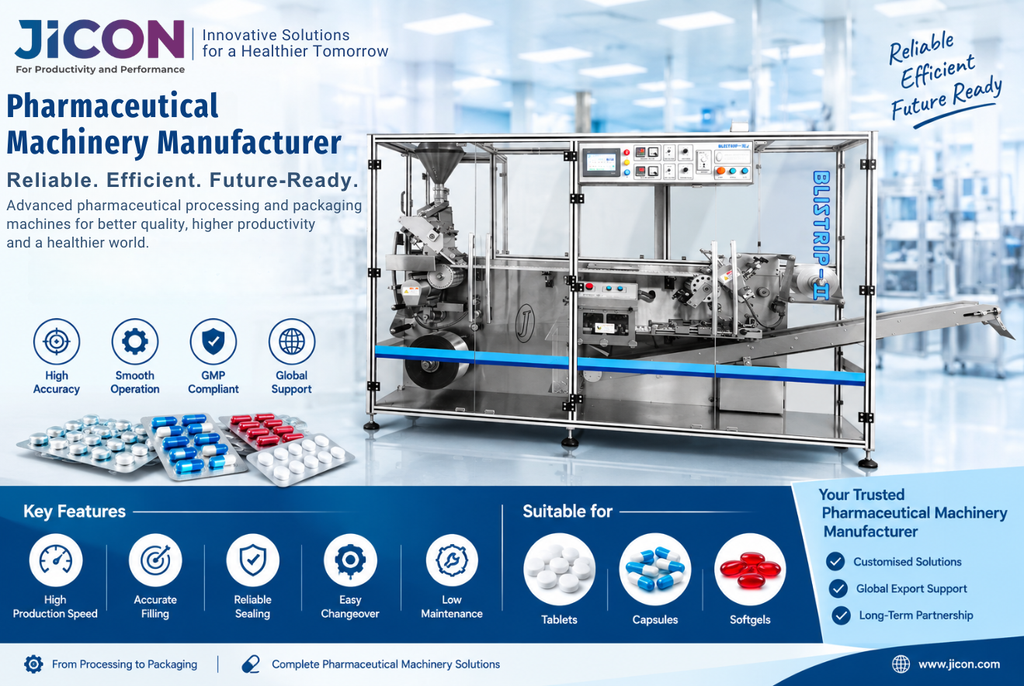
Pharmaceutical Machinery Manufacturer: 7 Powerful Ways to Improve Pharma Production
Pharmaceutical Machinery Manufacturer is more than a search term for pharmaceutical companies—it represents an important decision when selecting equipment for reliable, efficient and scalable production.
Pharmaceutical manufacturing requires precision at every stage. From processing and filling to blister packaging and cartoning, each machine contributes to product quality, production efficiency and packaging consistency.
Choosing the right machinery manufacturer can therefore have a direct impact on productivity, operational reliability and long-term manufacturing performance.
With growing demand for automation and efficient pharmaceutical packaging, manufacturers are increasingly looking for machinery partners who understand both engineering requirements and the practical challenges of pharmaceutical production.
Table of Contents
- What Does a Pharmaceutical Machinery Manufacturer Do?
- Why Pharmaceutical Machinery Quality Matters
- 7 Powerful Benefits of Choosing the Right Manufacturer
- Pharmaceutical Processing and Packaging Machinery
- How to Select a Pharmaceutical Machinery Manufacturer
- Automation and the Future of Pharmaceutical Manufacturing
- Why Choose an Experienced Indian Manufacturer?
- Jicon Technologies: Pharmaceutical Machinery Manufacturer
- Frequently Asked Questions
- Conclusion
What Does a Pharmaceutical Machinery Manufacturer Do?
A Pharmaceutical Machinery Manufacturer designs, manufactures and supplies equipment used in pharmaceutical processing and packaging operations.
The scope can include individual machines as well as equipment designed to work as part of a wider production or packaging line.
Depending on the manufacturer’s expertise, the machinery portfolio may include:
- Blister packaging machines
- Capsule filling machines
- Tube filling machines
- Cartoning machines
- De-blistering machines
- Tablet and capsule packaging equipment
- Pharmaceutical processing equipment
- Automatic and semi-automatic packaging systems
A good manufacturer does not simply sell a standard machine.
The manufacturer should first understand the customer’s product, pack size, production requirement, available space and automation expectations. This information helps determine the most suitable machine configuration.
Why Pharmaceutical Machinery Quality Matters
Pharmaceutical products require controlled manufacturing and packaging processes.
Packaging machinery must therefore provide dependable operation, consistent output and suitable construction for the intended application.
A machine that operates reliably can help manufacturers reduce unnecessary downtime, minimize product wastage and maintain a more consistent production process.
Machine quality also becomes important over the long term.
A pharmaceutical company may use its equipment for many years. Easy maintenance, availability of spare parts, technical support and the ability to adapt the machine to changing production requirements can therefore be just as important as the initial purchase price.
For GMP-related guidance, pharmaceutical manufacturers can refer to internationally recognized resources such as the World Health Organization’s Good Manufacturing Practices guidelines.
7 Powerful Benefits of Choosing the Right Pharmaceutical Machinery Manufacturer
1. Better Production Consistency
Production consistency is one of the primary advantages of properly selected pharmaceutical machinery.
Automated and semi-automated equipment can reduce variations caused by repetitive manual operations.
Consistent machine operation can contribute to more uniform filling, packaging, sealing and product handling.
2. Improved Production Efficiency
The right machinery can help manufacturers achieve better production efficiency without unnecessarily increasing manpower requirements.
Automation can reduce repetitive manual tasks and allow operators to focus on machine monitoring, quality checks and other important activities.
3. Reduced Product Wastage
Accurate filling, controlled feeding and reliable packaging processes can help reduce avoidable product losses.
For pharmaceutical manufacturers, even a small reduction in product wastage can become meaningful when production volumes increase.
4. Greater Packaging Accuracy
Pharmaceutical packaging often involves specific pack dimensions, materials and product configurations.
A suitable packaging machine should be selected according to these requirements.
Correct machine configuration helps improve packaging consistency and reduces the possibility of avoidable packaging defects.
5. Easier Production Expansion
Manufacturing requirements can change over time.
A pharmaceutical company may begin with a semi-automatic machine and later require higher automation or greater production capacity.
Working with an experienced Pharmaceutical Machinery Manufacturer makes it easier to discuss future requirements and possible machine upgrades.
6. Technical Support
Machinery performance does not end when the equipment is delivered.
Installation, commissioning, operator training, maintenance and spare-parts support can all influence the machine’s long-term value.
A manufacturer that provides appropriate technical support can help customers maintain smoother production operations.
7. Better Long-Term Investment
The cheapest machine is not necessarily the most economical machine.
A machine should be evaluated according to its complete lifecycle, including productivity, maintenance, downtime, spare parts, operator requirements and future production needs.
This approach helps pharmaceutical companies make more informed capital-equipment decisions.
Pharmaceutical Processing and Packaging Machinery
A modern pharmaceutical facility may require several different types of machinery depending on its manufacturing and packaging process.
Blister Packaging Machines
Blister packaging machines are commonly used for tablets, capsules and other solid pharmaceutical dosage forms.
The equipment can perform operations such as forming, product feeding, sealing and cutting depending on the machine configuration.
Jicon Technologies offers automatic blister packaging solutions such as the Blistrip-I and Blistrip-II series.
Capsule Filling Machines
Capsule filling machines are used to fill powder or other suitable formulations into hard capsules.
Production requirements can vary considerably, so capsule size, formulation characteristics, output and automation level should be considered when selecting equipment.
Jicon’s capsule filling portfolio includes the Ensule-750 and Ensule-2000 models.
Tube Filling Machines
Tube filling machines are used for products such as creams, ointments, gels and other suitable viscous formulations.
Depending on the configuration, equipment can handle aluminium, plastic or laminated tubes.
For pharmaceutical manufacturers requiring tube packaging solutions, selecting an experienced machinery manufacturer can simplify the process of determining the appropriate filling and sealing configuration.
Cartoning Machines
Cartoning machines automate the process of placing products and associated components into cartons.
A properly integrated cartoning system can help improve packaging-line efficiency and reduce repetitive manual handling.
Jicon’s CT-100 Automatic Cartoning Machine is designed for automated cartoning applications.
De-Blistering Machines
De-blistering equipment can be used to recover tablets or capsules from blister packs.
This type of machinery can be particularly useful where product recovery is required and can help reduce unnecessary product waste.
Jicon’s Blistpop De-Blistering Machine is developed for this application.
How to Select a Pharmaceutical Machinery Manufacturer
Selecting a supplier should begin with understanding your own production requirements.
Before requesting a quotation, prepare a clear URS or basic machine requirement covering the following information:
| Requirement | Information to Prepare |
|---|---|
| Product | Product type and characteristics |
| Production capacity | Required output per hour |
| Pack size | Minimum and maximum pack dimensions |
| Packaging material | PVC, PVDC, aluminium, laminate, etc. |
| Automation | Semi-automatic or automatic |
| Machine speed | Target production speed |
| Available space | Production-room dimensions |
| Utilities | Electrical, compressed air and other requirements |
| Changeover | Required product/pack-size changeovers |
| Documentation | Required technical and quality documents |
| Installation | Site installation and training requirements |
Providing these details helps the manufacturer recommend a suitable machine rather than offering a generic configuration.
Automation and the Future of Pharmaceutical Manufacturing
Automation is becoming increasingly important in pharmaceutical production and packaging.
However, automation should not simply mean adding more automatic functions.
The objective should be to create a production process that is reliable, practical and appropriate for the manufacturer’s actual requirements.
Modern pharmaceutical machinery may incorporate automated product feeding, filling, sealing, rejection systems, inspection functions, coding and line integration.
The level of automation should be selected according to production volume, operator requirements, available space, budget and future expansion plans.
A well-planned automation strategy can improve productivity while maintaining better process control.
Why Choose an Experienced Indian Manufacturer?
India has developed a strong manufacturing base for pharmaceutical and packaging machinery.
For international buyers, an Indian Pharmaceutical Machinery Manufacturer can offer several practical advantages, including engineering expertise, manufacturing capability and competitive equipment costs.
However, buyers should evaluate suppliers based on more than price.
Important factors include:
- Manufacturing experience
- Machine engineering
- Product portfolio
- Quality of construction
- Documentation
- Customer references
- Spare-parts availability
- Technical support
- Export experience
- Customization capability
- After-sales service
The objective should be to establish a long-term technical relationship rather than simply complete a one-time equipment purchase.
Jicon Technologies – Pharmaceutical Machinery Manufacturer
Jicon Technologies Pvt. Ltd. is an Indian manufacturer of pharmaceutical processing and packaging machinery, established in 1984.
The company’s machinery portfolio covers several pharmaceutical packaging applications, including blister packaging, capsule filling, tube filling, cartoning and de-blistering.
Jicon focuses on automatic and semi-automatic pharmaceutical machinery designed according to customer application and production requirements.
Its product portfolio includes:
- Blistrip-I and Blistrip-II – Automatic Blister Packaging Machines
- Alblis-I, Alblis-II and Alblis-350 – Flat Plate Blister Packaging Machines
- Ensule-750 and Ensule-2000 – Capsule Filling Machines
- Filltube-60 and Filltube-120 – Tube Filling Machines
- CT-100 – Automatic Cartoning Machine
- Blistpop – De-Blistering Machine
For customers planning a new pharmaceutical packaging line, the machine selection process should begin with the product and packaging requirement.
Jicon’s technical team can evaluate the application and recommend an appropriate machine configuration based on pack size, product characteristics, required output and automation requirements.
Frequently Asked Questions
What is a Pharmaceutical Machinery Manufacturer?
A Pharmaceutical Machinery Manufacturer designs and manufactures machinery used for pharmaceutical processing, filling, packaging and related production applications.
What machinery is used in pharmaceutical packaging?
Common equipment includes blister packaging machines, capsule filling machines, tube filling machines, cartoning machines and de-blistering machines.
How do I choose the right pharmaceutical machinery?
Start by defining the product, pack size, packaging material, production output, automation level, available space and utility requirements. These details allow the manufacturer to recommend a suitable machine configuration.
Is automation important in pharmaceutical packaging?
Automation can improve productivity, process consistency and operational efficiency. The appropriate level of automation depends on the manufacturer’s production volume, product and business requirements.
Why is GMP important for pharmaceutical machinery?
GMP provides principles for controlled pharmaceutical manufacturing and quality assurance. Machinery should be selected and operated as part of an appropriate overall quality system.
Can pharmaceutical machinery be customized?
Depending on the manufacturer and machine type, equipment can often be configured according to product characteristics, pack dimensions, production capacity and customer-specific requirements.
What information should I provide when requesting a quotation?
Provide your product details, pack size, packaging material, required speed, production quantity, automation requirement and any available URS. Drawings or samples can also help the manufacturer understand the application.
Conclusion
Choosing the right pharmaceutical machinery manufacturer is an important step toward building a reliable and efficient pharmaceutical production or packaging operation.
The right equipment can contribute to better production consistency, reduced manual intervention, improved packaging accuracy and more efficient use of resources.
However, successful machinery selection depends on understanding the complete application.
Product characteristics, pack dimensions, production volume, automation requirements, utilities, available space and future expansion should all be considered before making a purchasing decision.
An experienced machinery manufacturer can help transform these requirements into a practical machine configuration.
For pharmaceutical companies looking for reliable processing and packaging machinery, Jicon Technologies provides a range of automatic and semi-automatic solutions designed for pharmaceutical applications.
Have a pharmaceutical machinery requirement? Share your product details, pack size and production target with Jicon Technologies to discuss the appropriate machine solution.