
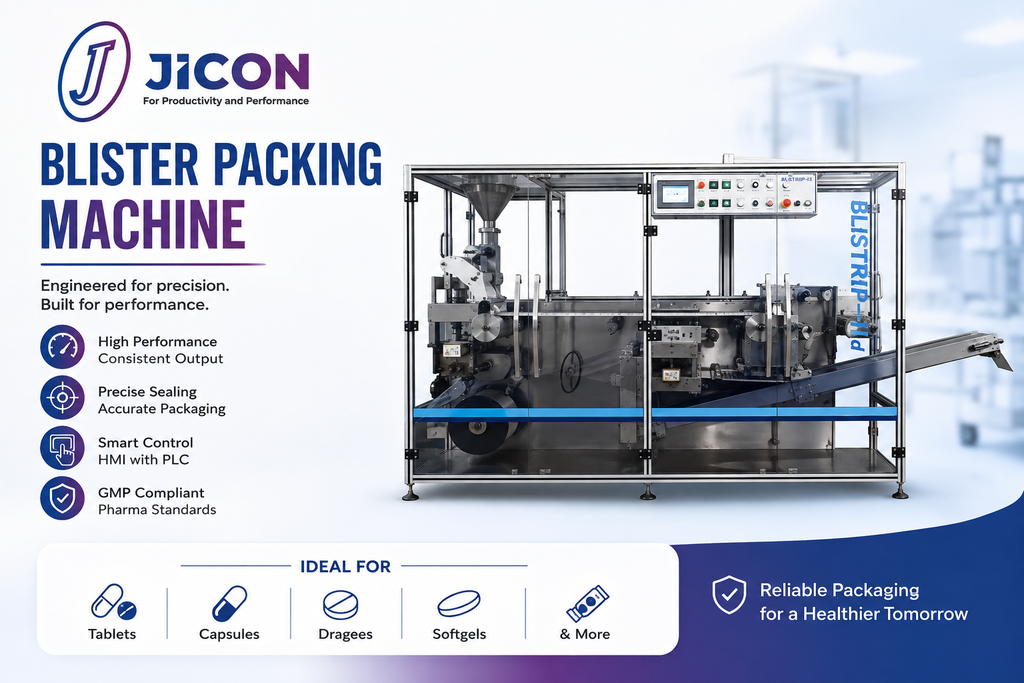
Blister Packing Machine: A Smarter Solution for Pharmaceutical Packaging
Blister Packing Machine technology has become an important part of modern pharmaceutical packaging. For manufacturers handling tablets, capsules and other solid dosage products, the packaging process needs to be accurate, reliable and consistent from the first pack to the last.
A well-designed blister packaging system can help manufacturers protect products from environmental exposure, maintain consistent pack quality, reduce manual handling and improve production efficiency.
But choosing the right machine is not simply about selecting the highest-speed model available. The machine should match the product, blister format, packaging material, production requirement, quality expectations and future expansion plans.
This guide explains the key considerations pharmaceutical manufacturers should understand before investing in a blister packaging solution.
Table of Contents
- What Is a Blister Packing Machine?
- Why Blister Packaging Is Important
- How a Blister Packing Machine Works
- Key Features to Look For
- Benefits of Modern Blister Packaging
- Packaging Materials Used
- GMP and Quality Considerations
- How to Choose the Right Machine
- Automatic vs. Semi-Automatic Blister Packaging
- Blister Packaging and Production-Line Integration
- Why Choose an Experienced Manufacturer?
- Why Jicon Technologies?
- Frequently Asked Questions
- Conclusion
What Is a Blister Packing Machine?
A Blister Packing Machine is a packaging system designed to form individual cavities, place products into those cavities and seal them with a suitable lidding material.
In pharmaceutical manufacturing, blister packs are commonly used for tablets and capsules because they provide individual product cavities and a convenient format for handling, storage and distribution.
Depending on the machine design, the packaging process can include:
- Forming the blister cavity
- Product feeding
- Product placement
- Lidding foil feeding
- Heat sealing
- Printing or coding
- Cutting
- Perforation
- Finished blister discharge
Modern machines can automate multiple stages of this process, helping manufacturers achieve greater consistency and reduce repetitive manual operations.
Why Blister Packaging Is Important
Pharmaceutical packaging is not simply an outer covering. It plays a role in protecting the product and maintaining its quality throughout its intended shelf life.
The World Health Organization notes that pharmaceutical packaging should help protect products from external influences such as moisture, light, oxygen, temperature variations, biological contamination and physical damage.
This makes packaging selection an important part of pharmaceutical manufacturing.
A properly designed blister pack can provide:
- Individual dose protection
- Product identification
- Convenient handling
- Protection during transportation
- Controlled presentation of tablets or capsules
- Space for batch and product information
The exact protection provided depends on the selected packaging materials, product characteristics and packaging design.
How a Blister Packing Machine Works
Although machine configurations vary, the basic process follows a logical sequence.
1. Forming
The base web is heated and formed into cavities according to the required blister format.
2. Product Feeding
Tablets or capsules are accurately fed into the formed cavities.
The feeding system should be selected according to the product shape, size, orientation and production speed.
3. Lidding
A suitable lidding foil is introduced over the filled blister web.
4. Sealing
The lidding material is sealed to the forming web under controlled conditions.
The sealing process must be consistent to produce a reliable blister pack.
5. Coding
Depending on the machine configuration, batch number, manufacturing information, expiry information or other identification details may be incorporated into the packaging process.
6. Cutting
The sealed web is cut into individual blister cards or the required pack configuration.
The finished blisters can then proceed to inspection, cartoning or another downstream packaging operation.
Key Features to Look For in a Blister Packing Machine
Not every pharmaceutical packaging line has the same requirements.
Before purchasing equipment, manufacturers should examine several important parameters.
Accurate Product Feeding
Product feeding is one of the most important aspects of blister packaging.
The feeding mechanism should accommodate the physical characteristics of the tablet or capsule while maintaining a stable production flow.
Poor feeding performance can lead to empty cavities, damaged products or production interruptions.
Consistent Forming
The forming station needs to produce cavities with repeatable dimensions.
Consistent cavity formation contributes to proper product positioning and reliable sealing.
Reliable Sealing
The sealing station should provide stable and repeatable sealing conditions.
Incorrect temperature, pressure, alignment or material selection can affect pack quality.
Easy Format Changeover
Pharmaceutical companies often produce multiple SKUs.
Therefore, changeover time can have a significant effect on production efficiency.
A machine designed for practical format changes can help reduce unnecessary downtime.
Product Inspection
Depending on the production line, inspection systems can be incorporated to identify missing, incorrectly positioned or defective products.
Inspection requirements should be discussed during the machine-selection stage.
7 Powerful Benefits of a Modern Blister Packing Machine
1. Better Product Protection
Blister packaging provides an individual cavity around each tablet or capsule.
The level of protection depends on the selected forming and lidding materials and the packaging design.
2. Improved Production Consistency
Automation helps reduce variation associated with repetitive manual packaging operations.
A properly configured machine can maintain a controlled packaging sequence throughout production.
3. Reduced Manual Handling
Automated feeding, forming, sealing and cutting can reduce the amount of direct operator involvement required during routine operation.
This can improve workflow and help manufacturers allocate operators to higher-value activities.
4. Better Packaging Presentation
A consistent blister format creates a professional appearance and makes individual doses easier to identify and handle.
For pharmaceutical brands, presentation and clear identification are important parts of the finished product experience.
5. Efficient Material Utilization
Machine settings and tooling can be optimized according to the required blister format.
Good process control can help manufacturers reduce unnecessary material consumption and product loss.
6. Easier Production Monitoring
Modern automated systems can provide operators with better control over machine parameters and production operations.
This can support more structured production monitoring.
7. Integration With Downstream Equipment
Blister packaging equipment can be integrated with downstream systems such as cartoning machines.
For high-volume pharmaceutical operations, integration can create a more continuous packaging workflow.
Packaging Materials Used in Blister Packaging
The selection of packaging material depends on the pharmaceutical product and its protection requirements.
Common blister packaging structures include combinations involving:
- PVC
- PVDC-coated structures
- Aluminium-based materials
- Aluminium foil
- Other specialized barrier materials
The correct material should be selected based on product stability, moisture sensitivity, light sensitivity, compatibility and intended shelf life.
WHO guidance emphasizes that packaging materials and systems must be appropriately considered because interactions between pharmaceutical products and packaging components can occur.
For this reason, packaging-material selection should involve the relevant pharmaceutical development and quality teams rather than being based only on machine compatibility.
GMP and Quality Considerations
A pharmaceutical packaging machine operates within a larger quality system.
The WHO describes Good Manufacturing Practices as part of a quality management system intended to ensure medicinal products are consistently produced and controlled according to appropriate quality standards.
For blister packaging operations, manufacturers should consider:
- Equipment design
- Cleaning procedures
- Changeover controls
- Packaging-material handling
- Product identification
- Line clearance
- Batch documentation
- Preventive maintenance
- Qualification and validation requirements
The WHO’s GMP compendium also covers areas such as equipment validation, quality management and inspection.
The precise qualification and validation strategy should be established according to the manufacturer’s quality system, applicable regulations and the specific application.
How to Choose the Right Blister Packing Machine
The correct machine should be selected from the production requirement backwards.
Start by defining the product.
Product Requirements
Consider:
- Tablet dimensions
- Capsule dimensions
- Product shape
- Product fragility
- Product characteristics
- Required pack configuration
Packaging Requirements
Define:
- Blister size
- Number of tablets per blister
- Number of blisters per strip
- Forming material
- Lidding material
- Printing requirements
- Coding requirements
Production Requirements
Determine:
- Required output
- Number of production shifts
- Number of SKUs
- Expected future capacity
- Changeover frequency
Facility Requirements
Also consider:
- Available floor space
- Electrical requirements
- Compressed-air requirements
- HVAC/environmental conditions
- Material flow
- Integration with existing equipment
A good machine specification should consider the complete production environment rather than only the machine’s headline speed.
Automatic vs. Semi-Automatic Blister Packaging
The choice between automatic and semi-automatic equipment depends on production requirements.
Automatic Blister Packaging
Automatic systems are generally suitable for manufacturers requiring higher levels of automation and consistent production output.
They can automate multiple stages of the packaging cycle and may be suitable for integration with downstream equipment.
Semi-Automatic Systems
Semi-automatic equipment may be appropriate for smaller production requirements, development environments, clinical batches or applications where production volumes do not justify a fully automated line.
The correct choice depends on actual production economics.
Blister Packaging and Production-Line Integration
For larger pharmaceutical facilities, the blister machine may be only one component of the packaging line.
A typical workflow can progress from:
Tablet/Capsule Production → Blister Packaging → Inspection → Cartoning → Case Packing → Secondary Packaging
Integration between machines can reduce manual transfers and improve overall line flow.
For example, Jicon’s pharmaceutical machinery portfolio includes blister packaging equipment as well as cartoning and other packaging solutions. Jicon Technologies pharmaceutical machinery
This broader capability can be useful when a manufacturer is planning a complete packaging solution rather than purchasing an isolated machine.
Why Choose an Experienced Manufacturer?
A blister packaging machine is a long-term capital investment.
The initial purchase price is only one part of the total cost.
Manufacturers should also consider:
- Engineering capability
- Machine reliability
- Availability of spare parts
- Technical support
- Installation
- Operator training
- Preventive maintenance
- Format change parts
- Future upgrades
- Integration capability
A supplier that understands pharmaceutical packaging can help identify practical issues before the machine reaches the production floor.
Why Jicon Technologies?
Jicon Technologies has been associated with pharmaceutical machinery manufacturing since 1984, with solutions covering pharmaceutical processing and packaging applications.
Its portfolio includes multiple blister packaging solutions, including BLISTRIP-II, BLISTRIP-Ixt and automatic flat-plate blister packaging equipment. Jicon’s published product portfolio identifies these machines under its tablet-section machinery.
For manufacturers evaluating a Blister Packing Machine, Jicon can be approached for discussions around product requirements, packaging formats, tooling, machine configuration and production-line requirements.
You can explore the company’s pharmaceutical machinery range through its official website.
For a specific blister packaging requirement, manufacturers should provide product samples, packaging-material details, blister dimensions, desired output and pack configuration so that the machine can be evaluated against the actual application.
Frequently Asked Questions
What is a Blister Packing Machine used for?
A Blister Packing Machine is primarily used to package products such as pharmaceutical tablets and capsules into formed cavities that are sealed with a suitable lidding material.
What products can be packed in blisters?
Blister packaging is widely used for tablets and capsules. The appropriate machine configuration depends on product dimensions, shape, characteristics and required production speed.
Which materials are used for blister packaging?
Depending on the application, blister packs may use PVC-based, PVDC-coated, aluminium-based and other barrier structures. Material selection should consider product stability and protection requirements.
Is blister packaging suitable for pharmaceutical products?
Yes. Blister packaging is widely used in pharmaceutical packaging. The appropriate packaging material and pack design should be determined according to the product’s protection and stability requirements.
How do I select the right blister machine?
Start with the product, blister dimensions, packaging material, required output, number of SKUs, changeover requirements and desired automation level.
Can a blister machine be connected to a cartoning machine?
Yes, depending on the machine configuration and line requirements, blister packaging equipment can be integrated with downstream cartoning equipment.
Conclusion
A Blister Packing Machine is more than a piece of packaging equipment. It is an important part of the pharmaceutical production system, where consistency, product protection, efficiency and quality control all matter.
The right machine should match the product, packaging material, required output and future production plans.
Before investing, manufacturers should evaluate actual product samples, conduct suitable machine trials, review changeover requirements and discuss qualification, validation and after-sales support.
For pharmaceutical companies planning a new packaging line or upgrading an existing one, working with an experienced machinery manufacturer can make the selection process more practical and reduce avoidable problems during installation and production.
If you are evaluating a blister packaging solution, discuss your tablet or capsule specifications, blister format, material, required production output and automation requirements with the machine manufacturer before finalizing the equipment.
Jicon Technologies Pvt. Ltd. — Pharmaceutical Processing & Packaging Machinery.