
Tube Filling Machine Exporter: Powerful Solutions for Pharma
Tube Filling Machine Exporter solutions have become increasingly important for pharmaceutical, cosmetic, healthcare, and personal-care manufacturers looking for reliable, accurate, and efficient tube filling operations.
Tube filling is not simply about putting a product into a tube. The process involves controlled dosing, tube handling, filling accuracy, sealing, coding, and final discharge. For manufacturers producing creams, ointments, gels, pastes, and other viscous formulations, the choice of filling equipment can directly influence productivity, product quality, and operating costs.
For this reason, working with an experienced Tube Filling Machine Exporter can make a significant difference when selecting equipment for a new production line or upgrading an existing facility.
Table of Contents
- What Is a Tube Filling Machine?
- Why Choose an Experienced Tube Filling Machine Exporter?
- Applications of Tube Filling Machines
- Key Features to Consider
- Aluminum, Plastic, and Laminated Tube Filling
- Importance of GMP-Oriented Machine Design
- How to Select the Right Machine
- Why Jicon Technologies?
- Frequently Asked Questions
- Conclusion
What Is a Tube Filling Machine?
A tube filling machine is designed to automatically or semi-automatically fill products into tubes and subsequently seal them for further handling and packaging.
Depending on the machine configuration, the equipment can handle different tube materials, product viscosities, filling volumes, and production requirements.
Typical products include:
- Pharmaceutical creams
- Ointments
- Gels
- Pastes
- Balms
- Cosmetic creams
- Personal-care formulations
- Healthcare products
A modern tube filling system can integrate several operations into one controlled process, including tube loading, tube orientation, product dosing, filling, sealing, batch coding, and tube discharge.
This reduces manual intervention while improving process consistency.
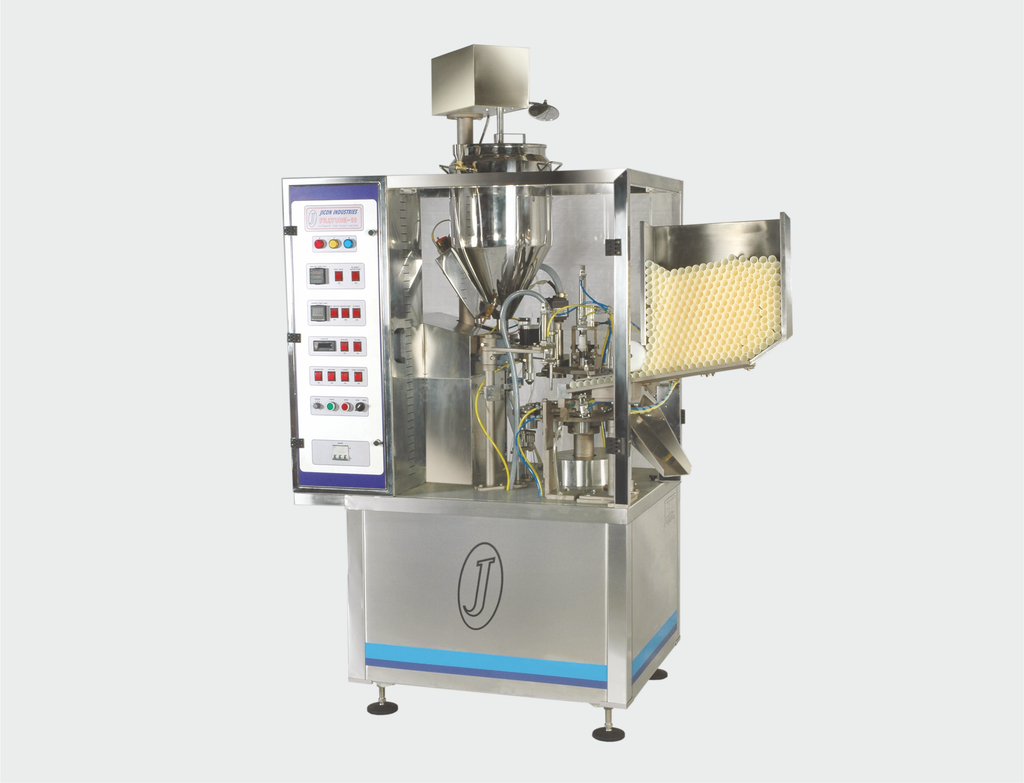
Why Choose an Experienced Tube Filling Machine Exporter?
Choosing machinery solely on the basis of price can create problems later. A reliable Tube Filling Machine Exporter should understand the complete application rather than simply supplying a machine.
The right supplier should evaluate:
- Product characteristics
- Filling volume
- Tube diameter
- Tube length
- Tube material
- Required production output
- Filling accuracy
- Sealing requirements
- Batch coding requirements
- Cleaning and maintenance needs
- Factory space and layout
- Future production expansion
This application-based approach helps manufacturers invest in equipment that fits their actual production requirements.
An experienced exporter can also support documentation, installation coordination, technical communication, and after-sales assistance for customers operating in international markets.
Applications of Tube Filling Machines
Tube filling technology is used across several industries.
Pharmaceutical Industry
Pharmaceutical manufacturers commonly use tube filling machines for creams, ointments, gels, and topical formulations.
The equipment needs to provide controlled filling and dependable sealing while supporting production processes aligned with the manufacturer’s quality requirements.
Cosmetic Industry
Cosmetic products such as creams, lotions, gels and other viscous formulations are frequently packaged in tubes.
Consistent filling helps create a uniform finished product and professional appearance.
Healthcare Products
Healthcare and personal-care products can also require tube-based packaging. Depending on the formulation, manufacturers may need specific dosing, sealing, and handling arrangements.
Food and Other Viscous Products
Certain food and specialty products can also be packaged in tubes. Machine configuration should be selected according to product viscosity, tube material, and filling characteristics.
Key Features to Consider Before Buying
When evaluating a Tube Filling Machine Exporter, buyers should look beyond the headline production speed.
1. Filling Accuracy
Accurate dosing is one of the most important characteristics of a filling machine.
Inconsistent filling can result in product giveaways, underfilled tubes, customer complaints, and production losses.
2. Production Capacity
The required output should be calculated based on actual production demand.
A machine designed for a small manufacturing operation may not be suitable for a high-volume facility, while an oversized system may unnecessarily increase capital expenditure.
3. Tube Compatibility
Manufacturers should confirm whether the equipment can handle:
- Aluminum tubes
- Plastic tubes
- Laminated tubes
Tube diameter and tube length should also be evaluated before selecting the machine.
4. Sealing System
Different tube materials require different sealing methods.
For example, aluminum tubes may use folding and crimping, while plastic and laminated tubes can require heat sealing or other suitable methods.
5. No-Tube-No-Fill
A no-tube-no-fill system helps prevent product from being dispensed when a tube is not correctly positioned at the filling station.
This can reduce unnecessary product wastage and improve process control.
Aluminum, Plastic, and Laminated Tube Filling
One of the important questions to discuss with a Tube Filling Machine Exporter is tube compatibility.
Aluminium tubes and plastic or laminated tubes behave differently during the filling and sealing process.
Aluminum tubes can typically be closed through folding and crimping. Plastic and laminated tubes generally require heat-based sealing systems.
Therefore, the machine configuration should be matched to the tube specification and finished-packaging requirements.
For example, Jicon’s semi-automatic tube filling equipment is designed for aluminum, plastic, and laminated tubes and can be configured for different product and tube requirements.
For more information, manufacturers can explore Jicon’s tube filling solutions:
Jicon Tube Filling Machine Solutions
Importance of GMP-Oriented Machine Design
Pharmaceutical packaging equipment operates within a highly controlled manufacturing environment.
Good Manufacturing Practices, commonly referred to as GMP, focus on ensuring that pharmaceutical products are consistently produced and controlled according to appropriate quality standards. WHO also highlights the importance of clearly defined, documented, and controlled production processes.
For this reason, pharmaceutical machinery should be designed with factors such as
- Product-contact material selection
- Cleaning accessibility
- Controlled product handling
- Prevention of contamination
- Reliable process operation
- Appropriate documentation
- Validation and qualification requirements
WHO guidance also identifies qualification and validation as important elements within pharmaceutical GMP systems.
External resource: Manufacturers can refer to the World Health Organization GMP guidelines for authoritative information on GMP principles.
How to Select the Right Tube Filling Machine
Before approaching a Tube Filling Machine Exporter, prepare the following information:
| Requirement | Information to Provide |
|---|---|
| Product | Cream, ointment, gel, paste, etc. |
| Filling range | Required minimum and maximum volume |
| Tube material | Aluminium, plastic or laminate |
| Tube diameter | Minimum and maximum diameter |
| Tube length | Minimum and maximum length |
| Required output | Tubes per hour |
| Sealing | Crimping, hot air, or required method |
| Coding | Batch number, MFG/EXP, etc. |
| Automation | Semi-automatic or automatic |
| Future expansion | Expected production growth |
Providing these details allows the machine manufacturer to recommend a more suitable configuration.
Why Jicon Technologies?
Jicon Technologies Pvt. Ltd. is an Indian manufacturer of pharmaceutical processing and packaging machinery, with experience dating back to 1984.
The company’s equipment portfolio includes tube filling solutions designed for pharmaceutical and other viscous-product applications.
Jicon’s tube filling equipment can be configured according to product, tube and production requirements rather than relying on a one-size-fits-all approach.
Explore related solutions:
- Automatic Tube Filling Machine – Jicon Technologies
- Automatic Cartoning Machine – CT-100
- Blister Packaging Machine – Blistrip-II
- Pharmaceutical Machinery – Jicon Technologies
For manufacturers planning international projects, technical support and communication are particularly important. A capable Tube Filling Machine Exporter should be able to understand the buyer’s application, provide appropriate documentation, and coordinate technical requirements throughout the purchasing process.
Frequently Asked Questions
What does a Tube Filling Machine Exporter do?
A Tube Filling Machine Exporter supplies tube filling equipment to customers in international markets and may provide technical documentation, configuration support, installation assistance and after-sales service.
What products can be filled into tubes?
Tube filling machines can be used for products such as creams, ointments, gels, pastes, balms, and other viscous formulations, subject to machine and product compatibility.
Can tube filling machines handle aluminum tubes?
Yes. Certain configurations are specifically designed for aluminium tubes and use folding or crimping systems for sealing.
Can the same machine handle plastic and laminated tubes?
Some machines can be configured for aluminum as well as plastic and laminated tubes. However, the filling and sealing system must be selected according to the specific tube type.
How do I choose the right tube filling machine?
Start with your product type, filling volume, tube dimensions, tube material, required production capacity and sealing method. A machine manufacturer can then recommend an appropriate configuration.
Is GMP compliance important for pharmaceutical tube filling?
Yes. Pharmaceutical manufacturers operate under controlled quality systems, and GMP provides principles for consistent production and quality control. Specific regulatory requirements depend on the country, product, and manufacturing operation.
Conclusion
Selecting the right Tube Filling Machine Exporter is about more than finding a machine with a suitable production speed.
Pharmaceutical manufacturers should consider filling accuracy, tube compatibility, sealing technology, machine construction, production requirements, maintenance, and long-term support.
A properly selected tube filling machine can help manufacturers achieve more consistent production, reduce manual intervention, and build a packaging process that is ready for future growth.
For pharmaceutical, cosmetic, and healthcare manufacturers looking for dependable tube filling technology, working directly with an experienced machine manufacturer can simplify the selection process and help ensure that the equipment matches the application.
Looking for a Tube Filling Machine Exporter for your next pharmaceutical packaging project? Contact Jicon Technologies to discuss your product, tube specifications, and production requirements.